

Finding the Right Puppy Starts with Finding the Right Breeder
Bringing a Labrador Retriever into your family is a commitment that may last 12 to 14 years or more. While many families focus on choosing the right puppy, the more important decision often comes much earlier: choosing the right breeder.
Not all breeders approach health, temperament, puppy development, and long-term support in the same way. The breeder you select will have a significant influence on your future dog’s health, personality, trainability, and overall quality of life.
Whether you are looking for a family companion, hunting partner, performance dog, or future show prospect, understanding what separates a responsible breeder from a puppy producer can help you make an informed decision.
Over the years, I’ve learned that the quality of a Labrador cannot be measured by a single characteristic. Health matters. Temperament matters. Correct breed type matters. Pedigree matters. The challenge for responsible breeders is balancing all four. Understanding that balance is one of the keys to choosing the right breeder.
The best Labrador breeders are not trying to maximize a single quality. They are striving to balance all the qualities that make a Labrador a Labrador.
Start with Your Goals
Before contacting breeders, spend some time thinking about what you hope to find in a Labrador.
Questions to consider:
- Is this primarily a family companion?
- Do you hunt?
- Are performance sports a future goal?
- Do you have young children?
- Do you want a highly active dog or a more moderate companion?
Different breeding programs emphasize different qualities, and understanding your own priorities helps you identify breeders whose dogs will fit your lifestyle.
Look Beyond the Puppies
Most Labrador puppies are adorable. That’s the easy part.
The harder question is what those puppies are likely to become over the next ten to fifteen years.
The real challenge isn’t finding a cute puppy. It’s finding the ethical breeder whose values and breeding decisions will produce a Labrador you will enjoy sharing your life with for the next decade or more.
Over the years, I’ve found that one analogy helps explain this better than any other. A well-bred Labrador is like a handcrafted table.

A Well-Bred Labrador Is Like a Handcrafted Table
Imagine a beautiful table built by a skilled craftsman.
Its strength depends upon four legs working together equally. If one leg is weak, the table becomes unstable. If one leg is significantly longer than the others, the table may appear impressive in one area, but it still won’t function properly.
In my view, a well-bred Labrador rests on four equally important foundations:
- Temperament
- Health
- Breed Type
- Pedigree
A responsible breeder should strive to maintain balance among all four. When one quality receives too much emphasis at the expense of the others, the result is an unbalanced dog.
It is easy to focus on a single characteristic. Some breeders prioritize show wins, others focus heavily on health clearances, while still others emphasize pedigree, color, or market trends. Yet no single quality can compensate for weaknesses in the others.
Responsible breeding is the ongoing pursuit of balance. The goal is not to produce a Labrador that excels in only one area, but a Labrador that possesses sound temperament, good health, correct breed type, and generations of thoughtful breeding behind it.
A Labrador is only as strong as its weakest leg. Excellence in one area cannot compensate for significant weaknesses in another.
Temperament
For most families, temperament is the quality they will experience every day for the life of the dog.
Temperament is much more than simply being “nice.”
It includes:
- Trainability
- Confidence
- Adaptability
- Resilience
- Appropriate energy levels
- Sound judgment
- Ability to live successfully as a family companion
When most people envision life with a Labrador, they picture a dog that enjoys family activities, welcomes visitors, learns readily, travels easily, and approaches life with enthusiasm and optimism. Those qualities are not accidental. They are traits that responsible breeders work hard to preserve and strengthen from one generation to the next.
Temperament is influenced both by genetics and by early experiences.

A Labrador may spend only moments in a show ring, but it spends a lifetime as a companion.
A Labrador should be friendly, stable, trustworthy, and eager to be part of the family. They should enjoy people, adapt to new situations with confidence, and possess a natural willingness to work alongside their owners.
Even the best puppy-raising program cannot completely overcome poor temperament genetics, just as excellent genetics can be undermined by inadequate early socialization. Responsible breeders pay careful attention to both.
One reason temperament deserves such high priority is that it touches every aspect of life with a dog. A Labrador may spend only a few weekends each year hunting, competing, or attending dog shows, but it spends every single day interacting with its family. The ability to settle comfortably in the home, interact appropriately with people and other animals, recover from new experiences, and respond willingly to training has a tremendous impact on the overall ownership experience.
This is why responsible breeders look beyond surface-level friendliness when evaluating their dogs. They observe how dogs respond to stress, how they recover from unexpected situations, how they interact with strangers, children, and other dogs, and whether they consistently demonstrate the stable, confident disposition for which the Labrador Retriever is known.
When speaking with a breeder, ask about the personalities of the parents and other relatives within the pedigree. Ask what traits are consistently seen in previous litters. Ask what strengths the breeder is hoping to preserve and what areas they are actively working to improve.
Just as with health, no bloodline is perfect. Some dogs may be more outgoing, while others are more reserved. Some may be higher drive, while others are more laid back. The important question is whether the breeder understands those differences and is making thoughtful decisions with temperament in mind.
The vast majority of Labrador owners are seeking a lifelong companion. Most Labradors spend far more time in family rooms than they do in show rings, hunting blinds, or competition venues. For that reason, temperament should never be treated as an afterthought.
Health
Health testing is vitally important, but health encompasses much more than a collection of certificates.
Responsible Labrador breeders should perform the recommended health clearances and be willing to provide documentation. In Labradors, buyers should expect breeders to discuss:
- OFA Hip Certification
- OFA Elbow Certification
- Annual eye examinations by a veterinary ophthalmologist
- Advanced cardiac evaluation performed by a veterinary cardiologist
- DNA testing for inherited Labrador diseases such as PRA, EIC, CNM, and HNPK
These tests help breeders make informed breeding decisions and reduce the risk of passing known inherited conditions to future generations.
However, health clearances are only one piece of the puzzle.
A breeder can perform every available test and still fail to evaluate the overall health picture within their bloodlines. Good health is about much more than what can be measured on a single day by a single test.
Responsible breeders should also pay close attention to traits and conditions that affect quality of life, longevity, and overall well-being, including:
- Cancer incidence within the pedigree
- Epilepsy and seizure disorders
- Allergies and chronic skin conditions
- Autoimmune disease
- Orthopedic concerns beyond formal clearances
- Longevity of family members
- Reproductive soundness
- General vigor and quality of life as dogs age
Some of these conditions cannot be eliminated through a simple DNA test. They require years of observation, honest record-keeping, and a willingness to have difficult conversations about the strengths and weaknesses within a breeding program.
One of the most important qualities to look for in a breeder is honesty.
No bloodline is perfect. Every pedigree contains strengths and weaknesses. Responsible breeders recognize those realities and make thoughtful choices intended to improve future generations rather than pretending problems do not exist.
When speaking with breeders, don’t hesitate to ask questions such as:
- How long do dogs from your bloodlines typically live?
- What health concerns have you encountered over the years?
- Have cancer, allergies, or seizures appeared in the pedigree?
- What challenges are you actively trying to improve?
- Why did you select this particular breeding?
A knowledgeable breeder should be comfortable discussing both successes and challenges.
Ultimately, health testing should be viewed as a starting point, not the finish line. Health clearances provide information. Responsible breeding requires wisdom in how that information is used.
Just as one weak leg destabilizes a handcrafted table, serious health concerns can undermine every other quality a Labrador possesses. The goal is not simply to produce dogs that pass a series of tests. The goal is to produce Labradors that enjoy long, healthy lives as cherished family companions.
Breed Type
Breed type is often misunderstood as simply appearance.
A Labrador should certainly look like a Labrador. Correct structure contributes to sound movement, athletic ability, and long-term physical durability. The broad head, weather-resistant coat, powerful otter tail, balanced proportions, and sound movement described in the breed standard are not arbitrary. These traits developed because they enabled the Labrador to perform the work for which the breed was originally developed.
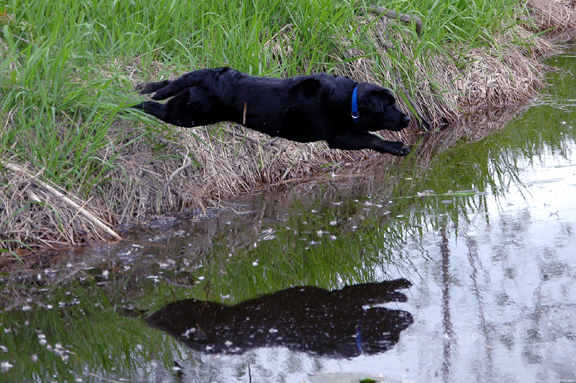
But breed type is about much more than appearance.
A Labrador should also act like a Labrador.
A correct Labrador should demonstrate:
- Natural retrieving instinct
- Love of water
- Desire to please
- Intelligence
- Willingness to work
- Kindness and stability
The Labrador Retriever was developed as a working partner. While most Labradors today live as beloved family companions rather than working gundogs, the qualities that made the breed successful in the field remain important. A Labrador should be eager to engage with its owner, willing to learn, and naturally inclined to retrieve. These instincts are part of the breed’s heritage and should not be lost.
Correct breed type also supports long-term function. A Labrador should possess the structure necessary to move efficiently, swim comfortably, retrieve enthusiastically, and remain physically sound throughout its life. The goal is not simply to produce a dog that looks good standing still, but one that is capable of doing the work for which the breed was designed.
For this reason, I believe it is important to evaluate the whole dog. Structure, movement, temperament, instinct, and overall breed character are inseparable. A Labrador that possesses beautiful conformation but lacks Labrador temperament or working instinct is incomplete. Likewise, a dog with wonderful temperament and retrieving desire but poor structure may struggle to remain sound and active throughout its lifetime.
Ultimately, breed type is the combination of form and function.
A Labrador should not only look like a Labrador. It should think, move, and behave like a Labrador as well.
It is the complete package of appearance, movement, instinct, temperament, and purpose that allows a Labrador to be unmistakably Labrador.
A beautiful dog that lacks Labrador character is no more correct than a structurally unsound dog with wonderful temperament.
The Labrador Retriever became one of the world’s most beloved breeds because of its complete package of form, function, and character. Responsible breeders work to preserve all three.
Pedigree
Pedigree is much more than a list of famous names, championship titles, or impressive accomplishments.
A well-researched pedigree allows a breeder to study generations of dogs and identify patterns in:
- Temperament
- Health
- Longevity
- Trainability
- Structure
- Consistency
While genetics never offers guarantees, generations of carefully selected dogs make desired outcomes more predictable.
The best breeders are students of pedigrees. They understand not only the dogs they own, but the parents, grandparents, siblings, aunts, uncles, and generations that came before them. They spend years gathering information, talking with other breeders, evaluating dogs from related breedings, and searching for patterns that may not be obvious from simply looking at a pedigree on paper.
One of the most misunderstood concepts in dog breeding is the difference between producing an exceptional individual and consistently producing quality Labradors.
Almost any pedigree can occasionally produce an outstanding puppy. Exceptional individuals can emerge from unexpected places. However, responsible breeding is not about producing a single remarkable dog. It is about producing quality dogs generation after generation.
A deep pedigree filled with dogs that consistently demonstrate sound temperament, good health, correct breed type, trainability, and longevity gives a breeder far greater confidence in what future generations are likely to produce. The goal is not to hit the genetic lottery once. The goal is to stack the odds in favor of producing well-rounded, predictable Labradors time and time again.
Responsible breeding is not about producing one exceptional dog. It is about consistently producing exceptional generations.
For prospective puppy buyers, consistency matters.
Most families are not searching for the once-in-a-generation show dog or field champion. They want confidence that their puppy is likely to mature into the kind of Labrador they hoped for when they started their search: healthy, trainable, stable, and capable of becoming a cherished member of the family.
That predictability is one of the greatest values of responsible breeding.
When breeders carefully study pedigrees and make thoughtful breeding decisions, they increase the likelihood that the qualities they value will continue to appear in future generations. While there are never guarantees, generations of dogs exhibiting the same desirable traits create a far stronger foundation than relying on chance alone.
When a breeder can explain why a particular breeding was planned, what qualities they hope to preserve, what strengths complement one another, and what areas they hope to improve, it demonstrates thoughtful decision-making rather than simply producing puppies.
A pedigree should tell a story. Not a story about a single famous dog, but a story about generations of Labradors consistently exhibiting the qualities that responsible breeders work so hard to preserve.
Evaluate the Breeder, Not Just the Dog
A responsible breeder should be able to discuss all four legs of the table in detail.
They should be able to explain:
- Why a particular breeding was planned
- The strengths and weaknesses of the parents
- What qualities they hope to preserve
- What challenges they are actively working to improve
No breeder has perfect dogs. The best breeders are honest about both strengths and weaknesses and continually work toward improvement.
A responsible breeder should be able to explain not only what they do, but why they do it.

Learn About Puppy-Raising Practices
Even the best pedigree and the healthiest parents are only part of the equation.
The experiences puppies receive during their first eight weeks can have a profound impact on their development.
Ask breeders:
- Where are puppies raised?
- Are they exposed to everyday household noises?
- How are they socialized?
- Do they experience a variety of surfaces and environments?
- How are individual temperaments evaluated?
Responsible breeders invest considerable time helping puppies develop confidence, resilience, and adaptability before they ever leave for their new homes.
Look Beyond Titles
Championships, hunting titles, performance titles, and other accomplishments provide useful information.
They demonstrate that a dog has been evaluated against a standard or tested in an activity.
However, titles alone should not be the deciding factor.
A pedigree filled with champions means little if health, temperament, or quality of life have been ignored.
Instead, look for balance among all four legs of the table.
A breeder’s goal should never be to maximize only one characteristic.
Pay Attention to How the Breeder Communicates
A responsible breeder should be interviewing you just as carefully as you are interviewing them.
Expect questions about:
- Your family
- Your lifestyle
- Your previous dog experience
- Your goals
- Your expectations
This isn’t being difficult.
It’s evidence that the breeder cares where their puppies go.
A breeder who is willing to place a puppy with anyone who has money in hand should cause concern.
Expect Lifetime Support
Responsible breeders view puppy placement as the beginning of a relationship, not the end of a transaction.
Ask prospective breeders:
- Will they answer questions after the puppy goes home?
- Will they provide guidance if challenges arise?
- Will they remain available throughout the dog’s life?
- Will they accept a dog back if circumstances change?
A breeder’s commitment should extend far beyond puppy pickup day.
A breeder who is willing to answer questions years later is often demonstrating the same commitment that guided their breeding decisions in the first place.
Red Flags to Watch For
Be cautious if a breeder:
- Cannot provide health testing documentation
- Produces numerous litters continuously
- Always has puppies available
- Shows little interest in your family or lifestyle
- Cannot explain the reasoning behind a breeding
- Focuses primarily on color trends or marketing
- Makes unrealistic guarantees
Responsible breeding requires planning, patience, and a willingness to prioritize the future of the breed over convenience.
Ultimately, choosing a breeder is about understanding the philosophy that guides every breeding decision.

Our Philosophy at Skyfire Labradors
At Skyfire Labradors, every breeding decision begins with the goal of producing balanced Labradors supported by all four legs of the table: temperament, health, breed type, and pedigree.
No single quality should outweigh the others.
A Labrador with a spectacular pedigree but poor temperament is no more complete than a healthy dog lacking Labrador character or a beautiful dog with significant health concerns.
For more than three decades, our goal has been to produce Labradors that are healthy, trainable, structurally sound, and capable of excelling as devoted family companions while preserving the characteristics that have made the Labrador Retriever one of the world’s most treasured breeds.
Key Takeaways
- Choose your breeder before choosing your puppy.
- Look for balance rather than a single standout quality.
- Evaluate temperament, health, breed type, and pedigree together.
- Ask how puppies are raised and socialized.
- Seek breeders who provide lifelong support.
- Avoid programs that emphasize one characteristic at the expense of the whole dog.
The Labrador puppy you bring home will share your life for many years. Taking the time to choose the right breeder is one of the most important investments you can make.
Long before you choose a puppy, you are choosing the philosophy, priorities, and generations of breeding decisions that helped create that puppy.
Continue Your Research
If you’re evaluating Labrador breeders, you may also find these resources helpful:
- Skyfire Breeder FAQs
- Labrador Breed FAQs
- Understanding Health Testing in Labrador Retrievers (coming soon)
- Labrador Retriever Styles, English / American / Field / Show (coming soon)